
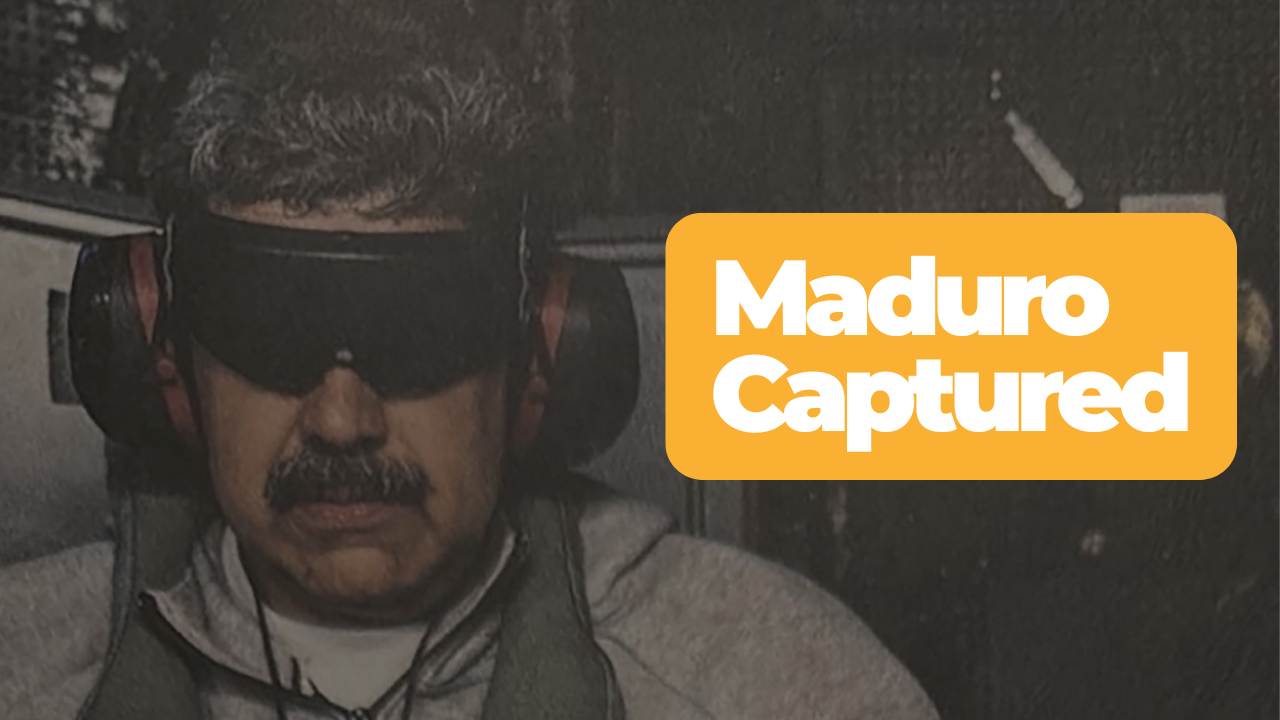
The news that broke on January 4th, 2026 was unprecedented in modern Latin American history: U.S. military forces captured Venezuelan President Nicolás Maduro and his wife Cilia Flores, transporting them to New York to face criminal charges. President Trump announced that the United States would assume temporary administrative control over Venezuela to facilitate what he called a “safe, proper and judicious transition” to democratic governance.
The international response has been predictably divided. Critics invoke the ghosts of American interventionism past, warning of sovereignty violations and imperial overreach. Supporters point to Venezuela’s catastrophic collapse and argue that external intervention represents the only realistic path to recovery. But beyond the moral and legal debates lies a more pragmatic question: will this intervention actually improve life for ordinary Venezuelans?
I believe the answer is yes—and that the historical record, properly understood, supports cautious optimism about Venezuela’s trajectory in the coming years.
The Baseline Matters: Venezuela’s Unprecedented Collapse
Any honest assessment of Venezuela’s future must begin with an unflinching look at its present. This is not a country experiencing political difficulties or economic recession. Venezuela has endured one of the most severe peacetime economic collapses in recorded history. Hyperinflation rendered the national currency worthless. Oil production, once the foundation of the state, fell to a fraction of its former capacity. Over seven million Venezuelans—nearly a quarter of the population—fled abroad. Those who remained faced chronic shortages of food, medicine, and basic services. Hospitals operated without supplies. Power grids failed regularly. Violence became endemic.
By virtually any comparative metric, Venezuela today ranks below countries that have experienced prolonged civil wars. This matters enormously because it fundamentally resets the terms of comparison. We are not debating whether foreign intervention is preferable to a functioning democracy—that choice does not exist. The real question is whether intervention can produce better outcomes than the continuation of a system that has already failed catastrophically.
When your baseline is national collapse, even imperfect change can yield dramatic improvements.
The Latin American Track Record: Better Than We Remember
Critics of U.S. intervention in Latin America have plenty of historical ammunition. The litany of American-backed coups, support for authoritarian regimes, and disregard for sovereignty is well documented and justly criticized. But history is more complex than simple condemnation allows, and the long-term outcomes of past interventions are more varied than the standard narrative suggests.
Consider Panama in 1989, when U.S. forces removed Manuel Noriega from power. The intervention was controversial, legally questionable, and involved significant civilian casualties. Yet Panama today is one of the most stable and prosperous countries in Central America, with functioning democratic institutions and a growing economy. The Canal Zone transition ultimately strengthened rather than weakened Panamanian sovereignty.
Or look at the Dominican Republic in 1965, where U.S. intervention in the civil war was widely condemned as imperialist meddling. The country experienced political turbulence for years afterward, but it did not descend into perpetual chaos. Today, the Dominican Republic is a middle-income democracy with robust growth and relatively stable governance.
Even the most problematic cases offer instructive contrasts with Venezuela’s present. Chile under Pinochet was a brutal dictatorship enabled by American support, yet Chile eventually transitioned to democracy and is now the most developed nation in South America. Guatemala and El Salvador endured horrific civil wars connected to U.S. Cold War policies, but both countries today—however imperfect—offer their citizens far more opportunity and security than contemporary Venezuela does.
The point is not to excuse past interventions or minimize their costs. The point is that Latin American countries that experienced heavy-handed external involvement in the late twentieth century are today, in most cases, more stable and prosperous than Venezuela currently is. That reality complicates any blanket assumption that non-intervention automatically produces better outcomes.
Why Latin America Is Not the Middle East
The comparison between Latin American interventions and those in the Middle East is instructive precisely because the outcomes have been so different. U.S. interventions in Iraq, Afghanistan, Libya, and Syria have resulted in protracted instability, sectarian violence, and in some cases, state collapse that rivals or exceeds the problems that prompted intervention.
The reasons for this divergence are complex, but several factors stand out. Middle Eastern societies often feature deep sectarian divisions between Sunni and Shi’a Muslims, between Arabs and Kurds, between religious and secular factions. These divisions, frequently suppressed by authoritarian regimes, tend to explode into violence when central authority collapses. Moreover, Islamist political movements—ranging from the Muslim Brotherhood to ISIS—offer ideological frameworks that can fill power vacuums and sustain insurgencies for decades.
Critically, many of these movements explicitly reject the legitimacy of secular, democratic governance on theological grounds. The Islamic State did not merely oppose American occupation; it opposed the entire modern nation-state system as un-Islamic. The Taliban in Afghanistan similarly rejects Western democratic norms as fundamentally incompatible with proper Islamic governance. These are not merely political disagreements but civilizational conflicts rooted in religious conviction.
Latin America presents a fundamentally different landscape. Venezuela, like its neighbors, is a predominantly Catholic society with a tradition of syncretism and pragmatism in religious matters. There is no Venezuelan equivalent of jihadist ideology—no theological framework that demands perpetual resistance to secular democracy or legitimizes terrorist violence as religious duty. Chavismo, for all its anti-American rhetoric, is a secular political movement grounded in socialism and nationalism, not religious fundamentalism.
This matters enormously for the prospects of stabilization. In the Middle East, removed dictators are often replaced by theocratic insurgencies or sectarian militias that prove even harder to dislodge. In Latin America, removed strongmen are typically followed by messy but ultimately manageable political transitions. Even in the worst cases—even when American-backed dictatorships ruled for years—the endpoint was usually a return to civilian, democratic governance, however flawed.
Venezuela faces serious challenges: political polarization, institutional weakness, endemic corruption, and the resource curse of oil dependency. But it does not face the prospect of a Taliban-style insurgency or an ISIS-like pseudo-state emerging from the chaos. The worst-case scenario in Venezuela looks far more like prolonged political dysfunction than civilizational collapse.
The Oil Question: Curse or Catalyst?
American officials have been explicit that restoring Venezuela’s oil production is central to their stabilization plan. This has prompted predictable accusations of resource theft and neo-colonial extraction. The criticism is not entirely unfair—Venezuela’s oil wealth has always attracted foreign interest, and there is no guarantee that restored production will benefit ordinary Venezuelans rather than foreign corporations and local elites.
Yet the economic logic of prioritizing oil is sound, even from a humanitarian perspective. Venezuela’s oil reserves are among the largest in the world, and its petroleum infrastructure, though degraded, still exists. Reviving oil exports would inject billions of dollars into the economy almost immediately, stabilizing the currency, enabling imports of food and medicine, and restoring government revenues needed to rebuild basic services.
More importantly, the alternative to restored oil production is not some pristine, non-extractive economy. The alternative is continued collapse. Venezuela cannot feed itself without imports, and it cannot afford imports without export revenues. The country’s only significant export commodity is oil. There is no realistic scenario in which Venezuela recovers without restoring petroleum production.
The legitimate concern is not whether oil production should be restored, but whether the revenues will be captured by a narrow elite or distributed broadly enough to rebuild the country. This depends entirely on institutional design and political accountability—questions that external intervention, for all its problems, may actually help resolve.
Consider the counterfactual: if Maduro’s regime had continued, would oil revenues have been distributed more equitably? The entire history of Chavismo suggests otherwise. The regime systematically looted state resources while ordinary Venezuelans starved. An externally supervised transition, whatever its flaws, at least offers the possibility of transparent revenue management and international oversight.
Even in the absolute worst case—if American oil companies captured the bulk of production profits—Venezuela would still benefit from the economic activity, employment, and tax revenues associated with a functioning petroleum sector. The Venezuelans who fled abroad could begin returning to actual jobs rather than a non-existent economy. Ports, refineries, and supply chains would operate again. The country would have something to build on.
This is not an argument for unregulated extraction or corporate plunder. It is an argument that Venezuela’s rock-bottom baseline means that even imperfect resource development would represent a significant improvement over the status quo of collapse.
The Democratic Legitimacy Question: More Complex Than It Appears
The most serious challenge facing Venezuela’s transition is not economic but political: legitimacy. Critics have framed the intervention as a purely unilateral American action imposed on an unwilling population. But this narrative obscures crucial facts that complicate the legitimacy question considerably.
Reports from Venezuelan diaspora communities worldwide—from Miami to Madrid, from Bogotá to Buenos Aires—show overwhelming celebration of Maduro’s removal. Social media has been flooded with videos of Venezuelans dancing in the streets, waving flags, and expressing relief that the regime has finally ended. Even within Venezuela itself, despite the communications blackout and security risks, spontaneous celebrations have erupted in multiple cities.
Importantly, this is not uncritical enthusiasm for American control. Venezuelans are expressing something more nuanced: profound relief that change is finally possible, mixed with understandable wariness about foreign oversight. As one Venezuelan exile put it, “We don’t love that it’s the Americans, but we’re grateful that someone finally did what needed to be done.”
This popular response matters because it undermines the narrative that the intervention is purely a violation imposed on an unwilling nation. When millions of Venezuelans—both inside and outside the country—are celebrating rather than resisting, the legitimacy calculus shifts dramatically.
Even more significant is the reported coordination between U.S. officials and Venezuela’s democratic opposition. The opposition, led by figures like María Corina Machado and Edmundo González, has long maintained that they won the 2024 presidential election—a claim supported by independent vote tallies and observer reports, despite the Maduro regime’s refusal to release official results. The regime’s theft of that election, coupled with the systematic persecution of opposition leaders, had left Venezuela’s democratic forces with no viable path to power through internal mechanisms.
If the intervention was indeed coordinated with the legitimate winners of Venezuela’s last election—the representatives who actually have a democratic mandate from the Venezuelan people—then the legitimacy picture becomes considerably more complex. This is not simply a foreign power installing its preferred government. It is, potentially, a foreign power helping to enforce an electoral result that the authoritarian regime refused to honor.
This does not erase all legitimacy concerns. Large segments of the Venezuelan population, even those who despised Maduro, will view any U.S.-imposed government with suspicion. Chavismo, as a political identity, has survived repeated failures precisely because it frames itself as resistance to foreign domination.
This creates predictable dynamics. As living standards improve, expectations will rise faster than institutions can deliver. Inequality will likely widen before it narrows, as urban centers and oil-linked sectors recover first while rural and marginalized communities lag behind. Nationalist resentment will coexist with material improvement. Venezuela may become livable again long before it becomes politically reconciled.
Yet this too offers grounds for cautious optimism when compared to the alternatives. Political division and resentment, however painful, are manageable problems compared to state collapse. Countries can function—even prosper—while remaining politically polarized. Chile’s economic miracle occurred under a hated dictatorship; its democracy came later but was built on that foundation. Poland and the Baltic states recovered from Soviet occupation despite massive popular resentment of external control. South Korea became an economic powerhouse while enduring decades of authoritarian rule.
The question is not whether Venezuela’s transition will be clean or universally welcomed. It won’t be. The question is whether it can establish a trajectory of material improvement substantial enough that opposition forces eventually compete within a system rather than seeking to destroy it. That is a lower bar than liberal democratic consolidation, but it is also a realistic one.
What Improvement Actually Looks Like
If the intervention succeeds—even partially—what will success look like for ordinary Venezuelans?
In the near term, likely within 18-24 months, we should expect: stabilization of food and medicine supplies as imports resume; restoration of basic services like electricity and water in major cities; a dramatic reduction in hyperinflation as currency chaos subsides; improved public safety as state security forces are reconstituted and criminal gangs face actual law enforcement; and the beginning of diaspora return as job opportunities emerge.
In the medium term, perhaps 3-5 years, we might see: functioning democratic elections, however imperfect and contested; restoration of oil production to levels that generate substantial government revenue; rebuilding of critical infrastructure including hospitals, schools, and transportation networks; emergence of a private sector beyond subsistence activities; and gradual improvement in Venezuela’s regional and international standing.
These are modest goals by the standards of functional democracies. They represent normalcy, not utopia. But for Venezuelans who have spent a decade watching their country disintegrate, normalcy would itself be revolutionary.
The comparison that matters is not between Venezuela’s possible future and an idealized democratic development. The relevant comparison is between any plausible intervention outcome and the certain continuation of collapse under Maduro’s regime. On that metric, even a messy, imperfect, deeply contested transition offers substantially better prospects.
The Uncomfortable Truth
There is something deeply uncomfortable about arguing that foreign military intervention could benefit Venezuela. It violates our principled opposition to violations of sovereignty. It contradicts our skepticism about American motives in Latin America. It forces us to acknowledge that sometimes, the least bad option involves accepting what would normally be unacceptable.
But discomfort with a conclusion is not an argument against its truth. Venezuela’s collapse was not merely a failure of governance but a humanitarian catastrophe that destroyed millions of lives. The Maduro regime was not merely authoritarian but actively predatory, systematically looting the country while its population starved. The opposition was not merely defeated but incapable of forcing change through any internal mechanism.
In such circumstances, clinging to anti-interventionist principles regardless of consequences becomes its own form of cruelty—a determination to let Venezuelans suffer indefinitely rather than accept imperfect help from a problematic source.
The historical record, properly understood, suggests that Latin American societies possess resilience and adaptive capacity that Middle Eastern interventions often lack. Venezuela does not face the civilizational conflicts that have torn apart Iraq and Afghanistan. It faces political, economic, and institutional challenges—serious ones, but challenges that are ultimately solvable.
The removal of Maduro, however it occurred, opens possibilities that did not exist before. Venezuela may finally have a chance to escape the death spiral of the past decade. The transition will be messy, contested, and morally ambiguous. But for the millions of Venezuelans who have already lost so much, mess and ambiguity are vastly preferable to the alternative of endless collapse.
Sometimes, the only way forward is through the uncomfortable middle ground between our principles and reality’s constraints. For Venezuela, that uncomfortable middle ground may finally offer a path back from the abyss.
The views expressed in this article are those of the author and do not necessarily reflect any official position. This analysis is based on reporting current as of January 4, 2026, in a rapidly developing situation.